Monday, July 16, 2012

Le Colonial


Le Colonial is a true find! It's located in an alley in downtown SF and this weekend we experienced the excellent French-Vietnamese food they’re famous for. Le Colonial is in the building that used to be the famed Trader Vic’s Restaurant on Cosmo Alley. The inner courtyard, which once housed legendary Trader Vic’s, has been transformed into an oasis featuring mosaic-like tile flooring, a vaulted, pressed-tin ceiling, tropical plants and plush rattan furniture accented by extensive candlelight. It’s an exotic beautiful space.

Upstairs Lounge
We began upstairs in the lounge that over looks Cosmo Alley. It has beautiful seating, whirling fans and strong, tasty drinks. We had the signature Le Colonial, a vodka-passionfruit puree, and a Viet Gimlet, a strong vodka-cucumber gimlet. Good drinks in wonderful surroundings.

Le Colonial advertises itself as French-Vietnamese and that it is. The tastes, preparation, and ingredients are all Vietnamese but the way in which the items are combined and put together has a new style with a modern french touch. This food is exceptional.

Patio Dining
From the lounge, we moved down to the the beautifully decorated outdoor patio and experienced fabulous service! Patient, quick, always-watching, they knew when to refill our water glasses and when we were ready for the main course instantaneously. The servers were nice, friendly, and patient.


The sommelier recommended a light french Pinot Noir which went perfectly with the French Vietnamese food. It turned out to be a nice change compared to the Reisling
we usually have with asian food.

Thit Kho Chien
For starters we began with Thit Kho Chien, a wonderful twice baked pork belly, savory pear, truffle oil and and quail egg on top. Another starter was Banh Xeo,a crispy crepe filled with lobster and shrimp. Hmm good!

Banh Xeo

Bo Luc Lac
Moving on to main dish, we had Bo Luc Lac. A wok seared Filet Mignon with garlic-soy sauce, pickled red onions and shoestring potatoes. Steak so tender you can cut it with a fork. 
Side dishes were Xu Bruxelles, sweet chili Nuoc Cham glazed brussels sprouts and portobello mushrooms that tasted great along with Com Dua, coconut rice which hit the spot too.
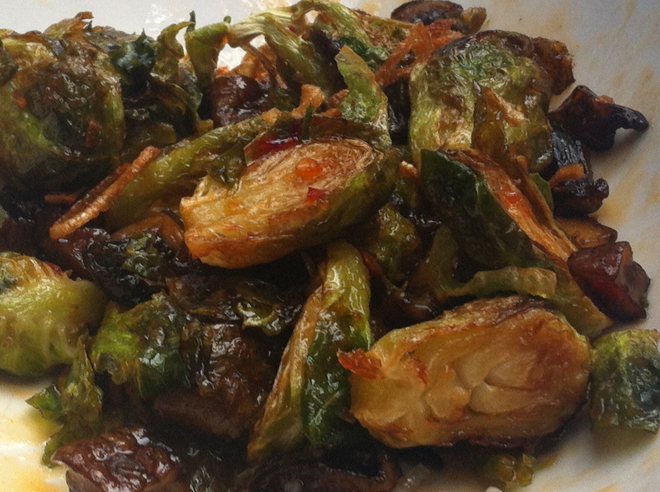
Xu Bruxelles with sweet chili Nuoc Cham glaze
Le Colonial is a favorite. The food is out of this world, a fantastic blend of French and Vietnamese. The mixed drinks decadently delicious and not skimped on in the least. There’s also an extensive wine list filled with top choices that will pair perfectly with your meal. You get what you pay for here… top notch French Vietnamese cuisine served with flair in an atmosphere that captures the essence of French colonized Vietnam and the modern world… 

Highly recommended!

If you want to check out the rest of the blog . . .Click here!

Monday, July 2, 2012

San Juan Bautista


Mission San Juan Bautista

We had a great trip to the town of San Juan Bautista near Monterey, CA. It’s an old town built around the Mission that was begun June 24, 1797 by Franciscan Father Fermin Lasuen. The mission was the 15th of 21 built by missionaries in the untamed new frontier of Alto California. Mission San Juan Bautista still serves as a local catholic church for the surrounding area. We were there Sunday and it was packed with local people.
Mission Bapistry
The mission was built along the El Camino Real or the King’s highway, which ran from Mission San Diego all the way to Mission San Francisco Solano in Sonoma. The mission settlements were approximately 30 miles (48 kilometers) apart, so that they were separated by one long day's ride on horseback along the 600-mile (966-kilometer) long El Camino Real.
Fault Scarp to the left of Original El Camino Real Roadway
Mission San Juan Bautista was built next to the famed San Andreas Fault. It's only about 100 feet from the mission walls. There’s a 15 foot cliff (fault scarp) that is visable and where the Pacific tectonic plate piles up against the North American plate. This old section of the original El Camino Real follows the fault itself, close to the mission. Very interesting.
Castro/Breen Adobe
There are many old buildings in San Juan Bautista including the Castro/Breen Adobe which originally was built as an adobe home in 1838 for Mexican General Jose Castro. The adobe then became a home for the Breen family who had survived 111 days in the Sierra Nevada Mountains as members of the Donner Party. The sixteen year old Breen son, John, set out for the gold fields in 1848 and returned with over $10,000.00 in gold dust. The Gold dust was used by the Breens to buy the adobe from the Castros and 400 acres of prime farmland nearby. 
Plaza Hotel
There’s also the Plaza hotel which was begun in 1814 as a one-story adobe barrack for the spanish soldiers who protected the mission. In 1865 Italian immigrant Angelo Zanetta leased the building and added a redwood second story that became the Plaza Hotel, opening in 1859. The Plaza was well known for it's fine dining and popular saloon.
Plaza Hall
Angelo Zanetta later remodeled an earlier mission building into Plaza Hall which became the large elegant Zanetta home. Many elegant events were held in the grand ballroom upstairs.
The Plaza Stable serviced the busy stagecoach and wagon traffic through San Juan Batista when it was a transpotation hub on the El Camino Real. There were up to 11 stage coaches a day that passed through San Juan Bautista on The Royal Road. Eventually the railroad bypassed the town and San Juan Bautista declined in importance.
San Juan Baptista Main Alter
The old mission itself has a peaceful, very restful kind of atmosphere. San Juan Bautista is a must see. Highly Recommended!
Check out the rest of the blog . . .Click here!

Thursday, June 21, 2012

Volcano


Union Inn and Pub

Volcano is an interesting little town that’s fairly easy to visit but still a bit off the beaten track. It’s a about a 2 or 3 block town of about 100+ inhabitants but can swell to 300 on weekend nights with people who come to see the professional theatre group, have dinner at the Union Inn and Pub, the St George Hotel (when it’s open) or music at the local bar. It’s all good.
Pork Tenderloin
We particularly like The Union Inn and Pub that's Taste restaurant’s sister property. Needless to say, the pub has delicious contemporary food. Had a very tasty pork tenderloin with fresh peach, wild and brown rice with pecans and fennel. Also had a superb Scott Harvey Old Vine Zin outdoors on the deck to complete the country-urban dining experience.
The Union Inn was built in 1880 by four itinerate French Canadians. It then became a boarding house for hard-working miners and locals until the 1920's. It was closed on and off for years and since being refurbished, it now has four modern guest rooms located on the second floor. Two rooms have direct balcony access overlooking Consolation Street and are modern and clean with flat panel TV. 
Historically, Volcano was named for its setting in a bowl-shaped valley which early miners thought was caused by a volcano. The early morning fog rising from the valley floor only reinforced that belief. The area was first known as Soldiers Gulch in 1849. By 1853 the area swarmed with miners, and there were 11 stores, 6 hotels, 3 bakeries, and 3 saloons. Hydraulic mining operations began in 1855 and brought thousands of fortune seekers who increased the town to 17 hotels, a library, a theater, and courts of quick justice. During the Civil War, Volcano's gold served the Union. Now, little Volcano has a few more than 100 inhabitants.
Main Street Volcano
For a small town, Volcano has had many firsts:
--1854 First theater group in California
--1854 First debating society in California
--1854 First circulating library in California
--1855 First private schools in California
--1855 First private law school in California
--1856 First legal hanging in Amador County
--1860 First astronomical observatory in California
--1978 First solar still in California
Can’t wait to get back to Volcano. It’s a quiet, yet happening little town that’s an appealing weekend get-away.
Highly Recommended!
Check out the rest of the blog . . .Click here!


Wednesday, June 20, 2012

Taste Restaurant


Taste on Main Street, Plymouth

Plymouth California is a great little town at the entrance to the Shenandoah Valley where many of the best grapes and wines are produced for the famed Amador County wines. Which brings us to Taste, a fantastic gourmet restaurant that produces the best food in the area and has wonderful wine flights of the local wines that are perfectly paired with the food.
Mushroom Cigars
Started our evening at the bar and the winemaker poured us six flights of great local Italian Barbera each for $10. What a deal. The winemaker poured the wines himself and took the time to explain the history of each wine. It was very interesting to hear and taste the wonderful story of Amador wine.
We then moved to our table which was ready with another set of Barbera wine flights to enjoy with the coming meal. The menu was varied, not your typical small town fare and it was great. Very urban in the small town of Plymouth. Owner/chef Mark Berkner’s dishes are perfectly suited to the wonderful Amador Wines. Our server certainly knew what he was doing and we began with the famed Mushroom Cigars which were made with Oyster, Crimini, Shiitake mushrooms along with fresh herbs and goat cheese wrapped in phyllo dough and baked to a golden brown.
Foie Gras
With Foie Gras being outlawed on July 1st in California, we had to have the chef’s special farewell dish of Foie Gras as an appetizer. Needless to say it was fantastic along with an almond sponge cake, grand marnier black pepper macerated strawberries and balsamic reduction. 
Rack of Lamb
The next course was Grilled Colorado Rack of Lamb with corn, Umbrian farro, arugala and blackberries. The rack of lamb paired with the flavorful Amador Barberas was about as perfect as it could get.
Finally, after all of this savory food, we had a rich Chocolate Honeycomb Cake made with chocolate sponge cake, dark decadent chocolate mousse, honeycomb wafer, salted caramel for dessert. This meal turned out to be one of the best meals we’ve experienced in a while. 
Slick, urban and well worth it. If you have the time and are looking for an outstanding meal, Taste is worth the visit.
Highly Recommended!
Check out the rest of the blog . . .Click here!

Shortest California Highway


Made a point of going to the James Marshall Monument and also made sure  to see the shortest highway in California.Of course, there’s a sign that says that State Route 153 (SR 153) is the shortest state highway. Cool.
It’s only 0.5 miles (0.80 km) long and it leads to the monument marking the grave of James Marshall whose discovery of gold along the American River, January 24, 1848 started the Gold Rush.
The Monument Road part of the “highway” is quite narrow, and looks like it dead ends at the park employee residence. But it doesn’t. There’s an easily missed sign that shows that the road continues in front of the residence as a very narrow, one way road up to the monument. There is a small parking area close to the monument on the one way road that circles it. 
James Marshall's cabin

St Johns Cemetary
The SR 153 officially ends at the Marshall Monument, but since the last short segment is only one way, you can't (legally) go back the way you came. The one lane, one way road continues down the hill and passes Marshall's cabin with old St Johns Cemetery across the road. It ends at the junction of Church and High streets in the town of Coloma.
Strangely fun and BTW, there was no traffic on the “highway”. 
Highly Recommended!
Check out the rest of the blog . . .Click here!

Columbia


City Hotel

While traveling around the Gold Rush area we made a point of returning to Columbia, the Gem of the Southern Mines. It’s a wonderful old town that never became a ghost town but did fall into disrepair until it was acquired by the State of California and turned into Columbia State Historical Park.

Columbia is a Gold Rush town that never died. If you're wondering what life was like in 1800’s, come here. Columbia State Park makes the preservation real. There are no cars in the historic area, it’s a quiet old town, especially after dark.

Like most towns in the Mother Lode, it's quite small. The state park portion is only a few blocks long; but then, so was Columbia in the 1800’s. It's good for a day trip, but you could also stay over night at the old time City Hotel. It has a fine dining room and is in the center of town. We’ve stayed there, it’s a great place.
Historically, the town started in 1850 when a handful of prospectors made camp near there. They found gold and before the month was out, a tent and shanty town housing several thousand miners was started. Its original name was American Camp and was soon changed to Columbia.

Streets were laid out, and in 1854, fire, the scourge of many mining towns, destroyed everything in Columbia's central district except the one brick building. When the town was rebuilt, locally produced red brick was used for 30 buildings. Iron doors and window shutters were included for additional fire protection.

At its peak, Columbia was the second largest city in California. Its businesses consisted of four banks, 30 saloons, 27 produce stores, hotels and an express office. The residents were thought to be “wicked,” because they brought in bears and bulls to fight each other for entertainment. Horace Greeley was said to have considered the opposition between “bears and bulls” the source for the famous Wall Street description of stock market dynamics.

Wilson-McConnell House
This was our second trip to Columbia and on our first trip we were lucky enough to meet Geraldine McConnell who was known as Mrs. Columbia. She was in her 90’s when we met her and she was very friendly and full of knowledge about Columbia. She was instrumental in saving the town working with Gov. Earl Warren but she unfortunately passed away at 99 years old. Her house, the Wilson-McConnell house was built 1878 and has been used in many movies including High Noon with Gary Cooper and Pale Rider with Clint Eastwood among many others. It’s a beautiful old house.
There is a lot to see and do in Columbia. It’s a wonderful old town, and it’s a must see if you’re in the Gold Rush area.
Highly Recommended!
Check out the rest of the blog . . .Click here!

Tuesday, June 19, 2012

Gold!


Full size reproduction of Sutter Mill

GOLD! We had a great time exploring the ghost town of Coloma where the California Gold Rush began. Coloma grew up around Sutter's Mill where gold was discovered. The name Coloma comes from the original Native American name for the valley, Cullumah, meaning "beautiful." Coloma is on the South Fork American River that runs through the valley, and was built on the site of an original Native American village of Koloma.

Original site of Sutter Mill
Marshall Gold Discovery State Historic Park site is situated where the Gold Rush began in 1848.Coloma is where John Sutter sent his foreman, James Marshall, to build a mill and process timber for his fort in Sacramento. As Marshall was building the mill on January 24, 1848, he looked down into the water in the tailrace (ditch) and picked up 4 pieces of metal that looked like gold. He took the metal flakes to back to Sutter who privately tested it and confirmed that it was gold. There’s a full size reproduction of Sutter’s Mill standing at the park now.

Original Sutter Mill in 1850. James Marshall standing in front
Sutter and Marshall tried to keep the discovery secret but rumors soon started to spread and were confirmed in March 1848 by San Francisco newspaper publisher and merchant Samuel Brannan. After Brannan had hurriedly set up a store to sell gold prospecting supplies, he then strode through the streets of San Francisco, holding a vial of gold, shouting "Gold! Gold! Gold from the American River!” People heard that cry and came from all over the world to grab some of that easy gold.

Actual trailrace (ditch) where gold was found January 24, 1848
The effects of the Gold Rush were substantial. The entire world was focused on the gold in California and it was one of the largest human migrations in history as a half-million people from around the world descended on California in search of instant wealth.

James Marshall's cabin in Coloma
Today, The Marshall Gold Discovery Park has a museum and a few well chosen buildings that give a sense of what life was like in those times. Now It’s a quiet, peaceful area along the beautiful South Fork of the American River. This is truly the very spot where the California Gold Rush began and where the history of California and the world was changed forever. Truly fantastic place!

Highly recommended!
Check out the rest of the blog . . . Click here!

Sutter Creek


Main Street Sutter Creek

Had a wonderful time experiencing the California Gold Country and stayed at the Foxes Inn. A B&B in the charming little town of Sutter Creek.
Sutter Creek, known as the Jewel of the Mother Lode, was named after John Sutter who sent James W. Marshall, his carpenter, to the area in 1846 in search of timber for his fort in Sacramento. Marshall’s later discovery of gold in nearby Coloma in January 1848 triggered the famed California Gold Rush.
Eureka Street
Sutter Creek became a destination for fortune hunters and became a town in 1854. A post office was established in 1852. Although plenty of placer gold was found there, gold-bearing quartz deposits were discovered in 1851 and mining those deposits for gold became the mainstay of the local economy for many years. The mines continued operations until 1942, when most gold mines were closed for a lack of manpower during World War II. They tried to reopen the mines after the war but they were finally closed in 1952. A few small mines are trying to run now because of the high prices for gold.
Foxes Inn
Today, Sutter Creek is a tourist town with many shops and restaurants. The town itself is a registered California Landmark. Many of the original brick buildings are still standing, as are some of the mansions built by wealthier residents. Leland Stanford, who started Stanford University, was one of Sutter Creek's most famous residents.
Foxes Parlor
One of the beautiful old houses on Main St has been turned into a charming B&B, The Foxes Inn. It’s a great place to stay. The staff excels at everything and goes out of their way to please. Gourmet breakfast was excellent every morning. It started with coffee from a silver pot and fresh fruit appetizer before the delicious breakfast entree! Among other dishes, they have a very creative and tasty Chile Relleno. Mmm, good.
The California Gold Country is a great place to go, and the Foxes Inn is a fantastic base for exploring the area.
Highly recommended!
Check out the rest of the blog . . .Click here!

Monday, June 11, 2012

Play Ball… Baseball!


Had a fantastic time seeing the local professional minor league baseball team at Albert Park in San Rafael, CA. Saw a great game and had wonderful grilled hotdogs along with beer.
2012 is the Inaugural Season for the San Rafael Pacifics, an independent minor league team playing in the North American Baseball League (NABL). The team will play home games at the historic Albert Park in downtown San Rafael. The Pacifics are an expansion team in the NABL.
Albert Park
Independent baseball isn’t part of the Major League Baseball system with its minor leagues, although the NABL skill level’s are comparable to AA or AAA teams.
As is usual for independent baseball, Pacifics players aren’t getting the big bucks. Some live with local families, who get free tickets in exchange for hosting the ballplayers. It's an old-time baseball experience compared to the major leagues. Much of the seating is on wooden benches or plastic chairs, and portable toilets take the place of built-in plumbing and it’s very fun!
Unfortunately the Pacifics lost to the Sonoma Grapes but it was still very fun, there were no sour grapes. The Pacific’s next series is against the Maui Na Koa Ikaika in Maui Hawaii.
In early July the Hawaiian team will make its first visit to San Rafael. It’ll be the Bay Area’s first look at Maui pitcher Eri Yoshida, a female player nicknamed the “knuckleball princess” whose debut drew international attention.
San Rafael Pacifics
The baseball game was fun, the stadium very intimate and the hot dogs as good as they get. 

Highly recommended!

Check out the rest of the blog . . .Click here!

Monday, June 4, 2012

Olompali


Eastern View from Olompali


Took a trip to Olompali, the ancient Native American Village grounds North of San Rafael, CA. Many things have happened at Olompali over the years, from the ancient native american times to the 1960’s with the Grateful Dead and a Hippie Commune. The site is now a California State Historic Park.
Redwood Bark Miwok House Site Reconstruction
The name Olompali comes from the Coast Miwok language and likely means "southern village" or "southern people". The Coast Miwok village site of Olompali dates back to about 500 CE, but Olompali had been a main center since 1200 CE, and might have been the largest native village in Marin County.
Miwok Tule Reed House Reconstruction
An Elizabethan silver sixpence minted in 1567 was discovered in the park by archeologists, indicating that villagers may have had contact with Sir Francis Drake or with people who had traded with the early English explorer. Many Miwok cultural artifacts have been identified, indicating this was once an important trade and cultural crossroads.
Protected Wall from Oldest Adobe North of SF Bay
The oldest house built north of the San Francisco Bay was built here in 1776 by the Coast Miwok out of adobe bricks. It was owned by the chief of the Olompali tribe Aurelio, who was the father of Camillo Ynitia. Camillo was known as the last Hoipu (Headman) of the Miwok community living at Olompali. In 1843, with the helpful petition of General Vallejo, the land was granted to Camillo Ynitia.
Original Burdell 1870's Frame House- Now Park Administration
Ynitia held onto the Olompali land title for 9 years, but in 1852 he sold most of the land to James Black of Marin for $5,200. In 1863, the land and adobe house passed from James Black to his daughter Mary (Black) Burdell and her husband Galen Burdell, a wealthy dentist. Mary's son James transformed Olompali into a country estate, he built a formal 26-room mansion that incorporated the foundations and rooms of Ynitio's original adobe house. Mary Burdell also had a formal garden in front of the mansion.
Ruins of James Burdell's 26 Room Mansion
The land and estate was eventually sold by the Burdell family to Court Harrington. Harrington in turn sold it to theUniversity of San Francisco to be used as a Jesuit retreat.
Grateful Dead Playing at the Burdell Mansion in 1966
During the 1960s, the University of San Francisco sold Olompali several times. Each time, the buyers defaulted and the property reverted back to the university. The most famous tenant was the rock band The Grateful Dead. During the Dead's brief stay it became a gathering place for San Francisco's rock musicians, including Janis Joplin, The Jefferson Airplane and Grace Slick among many others of the SF scene.
In 1967, Don McCoy leased Olompali, and started a hippie commune there called The Chosen Family. A fire caused by faulty wiring eventually destroyed the Burdell Mansion. Finally in 1977, the State of California purchased the land for the present State Park.
There’s great hiking trails to explore and a project is underway showing several structures representative of a Coast Miwok village. Visitors to the park can see two kotchas, indian houses, one made from redwood bark and another made with bundles of native tule reeds. Olompali is a great place. It’s a must see.
Highly recommended.
Check out the rest of the blog . . . click here